Thursday, July 7, 2022

Sri Lanka’s central bank


Sri Lanka’s central bank hikes interest rates to 21-year high

The move comes as inflation hit a record 54.6 percent and food inflation galloped to 80.1 percent.
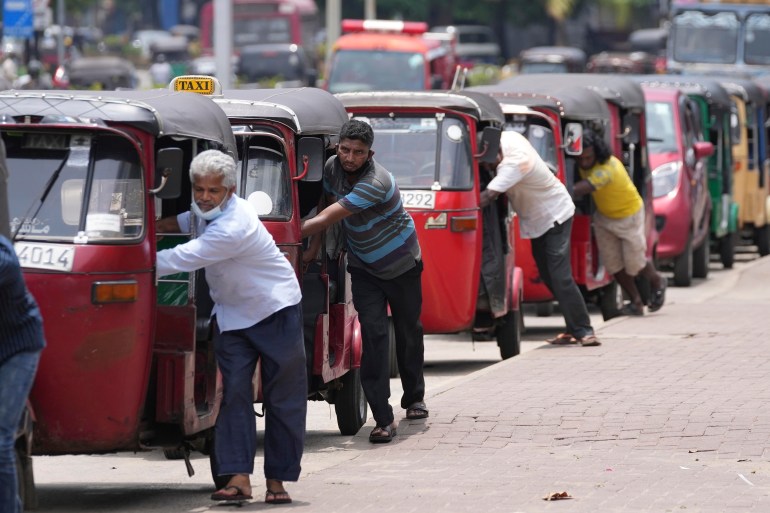
Auto drivers queue up for fuel in Colombo, Sri Lanka
The Sri lankan prime minister has said that the inflation rate will hit 60 percent in the coming months amid rising commodity prices and a declining currency
The Central Bank of Sri Lanka (CBSL) has raised borrowing costs to tackle record-high domestic inflation and to contain any build up of underlying demand.

The Standing Lending Facility rate was raised on Thursday by a full percentage point (or 100 basis points) to15.5 percent while the Standing Deposit Facility Rate rose by the same amount to 14.5 percent, the highest in 21 years.

The decision comes as inflation touched a record 54.6 percent year-on-year in June while food inflation accelerated to 80.1 percent. Prime Minister Ranil Wickremesinghe told parliament Tuesday, that the inflation rate will hit 60 percent in the coming months amid rising commodity prices and a declining currency.

“The Board was of the view that a further monetary policy tightening would be necessary to contain any build-up of adverse inflation expectations,” CBSL said in a statement.

The policy adjustment would help guide inflation expectations to be anchored around the targeted 4-6 percent level over the medium term and curtail any build up of underlying demand pressures in the economy, it said.

The island of 22 million people is wilting under a severe foreign exchange shortage that has it struggling to pay for essential imports of fuel, fertilisers, food and medicine.

Prior to Thursday’s decision, the country’s central bank had raised interest rates by 850 basis points since the beginning of the year, even as its economy contracted in the first quarter, marking the beginning of a painful and long recession for the country. Economic activity has also come to a grinding halt as the bankrupt nation asked residents to stay home until July 10 to conserve fuel.

There has been significant progress made in the negotiations with the International Monetary Fund for a credit facility while negotiations are on with bilateral and multilateral partners to secure bridge financing, the CBSL said.

“Bond yields shot up on Wednesday on the expectations of about a 500 basis point increase but what is interesting is the central bank is anchoring it’s decision on Sri Lanka seeing dis-inflation in the second quarter of 2023,” said Udeeshan Jonas, chief strategist at equity research firm CAL, referring to a slowdown in the rate of increase of prices of goods and services.

“Given the global changes, including oil prices trending downwards, it is clear the central bank is taking a measured approach and focusing on real interest rates and not matching cost-push inflation,” he added.
Wednesday, July 6, 2022

Dutch farmers block food warehouses over new environmental rules

Dutch farmers block food warehouses over new environmental rules

Fishers block ports in a show of support for farmers who blockaded supermarket distribution centres over new rules.

Some 25 tractors parked outside a distribution center for supermarket chain Albert Heijn during a blockade in the town of Zaandam
About 25 tractors parked outside a distribution centre for supermarket chain Albert Heijn in Zaandam 
Farmers in the Netherlands have blockaded supermarket distribution centres in continuing protests against new environmental rules on nitrogen emissions that are likely to put many of them out of business.

Fishers on Monday blocked ports in a show of support for farmers. The blockade prevented ferries from sailing to almost all the Wadden Islands off the country’s northern coast and caused lengthy delays, shipping companies reported.

Also on Monday, farmers used tractors and large bales of hay to block entrances to the supermarket distribution centres, as the association of food traders warned of supply bottlenecks.

The action had been announced in advance, with farmers calling for “the entire country to be paralysed”.

Airports had also made preparation for blockades on access roads. Traffic along most of the country’s dense road network was reported to be normal.

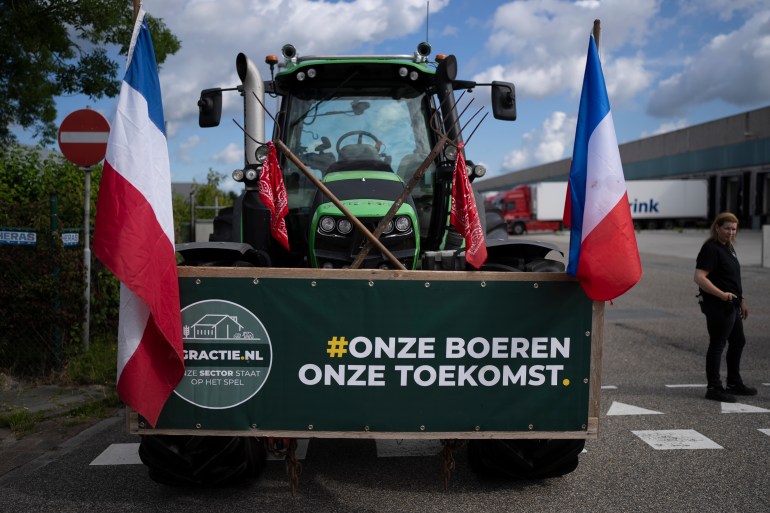
A sign reads "Our Farmers, Our Future" as some 25 tractors put up a blockade outside a distribution center for supermarket chain Albert Heijn in the town of Zaandam
A sign reads ‘Our Farmers, Our Future’ as about 25 tractors put up a blockade outside a
 distribution centre for supermarket chain Albert Heijn in the town of Zaandam 

Police said they would intervene if demonstrators moved to block access to Schiphol international airport near Amsterdam.

Over recent weeks, Dutch farmers have engaged in occasionally violent protests against environmental rules aimed at cutting back nitrogen emissions.

While other sectors, including construction, have also been hit, measures to curb the ammonia generated by livestock farming are a significant part of government plans.

Nitrogen emissions are to be cut by more than 70 percent in areas close to nature conservation areas. According to government estimates, this could lead to the shutting down of about 30 percent of livestock farms.

A 2019 ruling by the country’s highest court prompted the government to impose the measures.

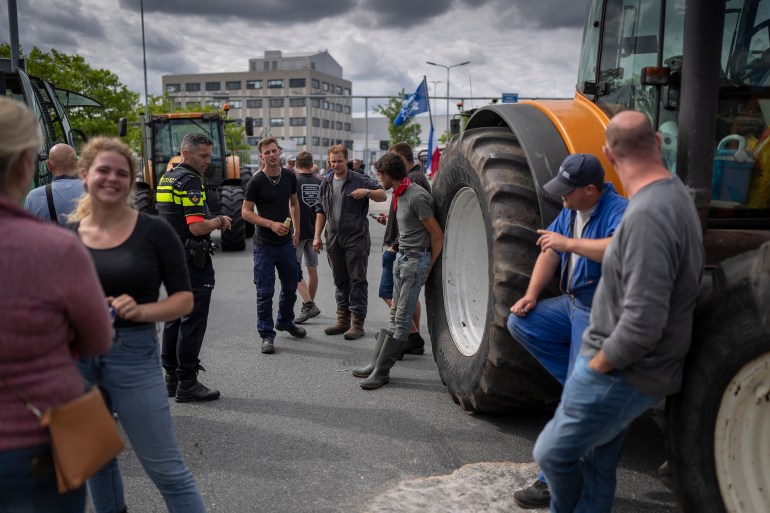
Police looked on but did not immediately take action Monday as some 25 tractors set up a blockade outside a distribution center for supermarket chain Albert Heijn in the town of Zaandam
Police look on as about 25 tractors set up a blockade outside a distribution 
 centre for supermarket chain Albert Heijn in Zaandam