Dutch farmers say plans by the government to reduce nitrogen emissions will harm their livelihoods.
Farmers in the Netherlands are blocking roads, setting fire to haystacks and even driving tractors through the streets of The Hague.
It is all in protest against laws that regulate emissions
produced by livestock, but will have a significant impact on the farming
community and the larger economy.
The
Netherlands has failed to meet its emissions reduction targets – so
permits for new homes and roads have not been granted since 2019, to
prevent further pollution.
And the government has introduced tough new rules.
Its $100bn food export industry – one of the biggest in the world – could be badly affected.
So, what will this climate policy mean for global food supplies?
I can turn around Sri Lanka’s economy: PM Ranil Wickremesinghe
Sri Lanka’s newly appointed prime minister says it will take one and a half years to stabilise the crisis-hit economy.
Colombo, Sri Lanka – Ranil Wickremesinghe, the newly
appointed prime minister of crisis-hit Sri Lanka, has said he is
confident he can turn the economy around – but cautioned it will take 18
months before stability returns.
“The year 2023 is going to be difficult, but by 2024 things should
pick up,” Wickremesinghe told Al Jazeera last week [Thursday] in a
wide-ranging interview at his official residence in the capital,
Colombo.
The
73-year-old leader, who in May became prime minister for the sixth
time, said that he took up the job under extraordinary circumstances.
“We had nearly two days without a government; things were getting out
of hand,” he said, recalling the mass protests over shortages of fuel
and electricity that forced Mahinda Rajapaksa, his predecessor and the
brother of President Gotabaya Rajapaksa, to resign.
“I thought ‘the situation is bad, it’s your country, so you can’t be
wondering whether you are going to succeed or not. You take it over and
work to succeed,’” said Wickremesinghe, who met the president at the
request of some MPs from the ruling Sri Lanka Podujana Peramuna party.
“I have confidence I can turn the economy around,” he said.
The island nation of 22 million has been brought to a virtual standstill
due to acute shortages of fuel and essential items such as food and
medicines, as the government ran out of foreign reserves to import
commodities earlier this year.
Sri Lanka defaulted on its external debt in April and
the usable foreign reserves are so low that it has struggled to cover
its needs from the international market.
In Colombo, the roads are nearly empty. Some long queues can be seen
near the few petrol stations that are still open, but educational
institutions, businesses and government offices remain shut. Hotels in
the capital – once full of tourists – are struggling to stay afloat due
to a sharp drop in guests.
Worst crisis since independence in 1948
Wickremesinghe, who has been tasked with lifting the country out of
its worst crisis since independence in 1948, said there will be petrol
shortages until at least July 22, when the next shipment is expected.
“We are buying fuel either using Indian credit lines or the foreign
exchanges that we get from remittances. It’s [remittances] a small
amount, but nevertheless, sometimes we get a billion dollar[s] or a
billion and a half. The rest of the reserves from what we got from the
creditors have already been busted,” he said.
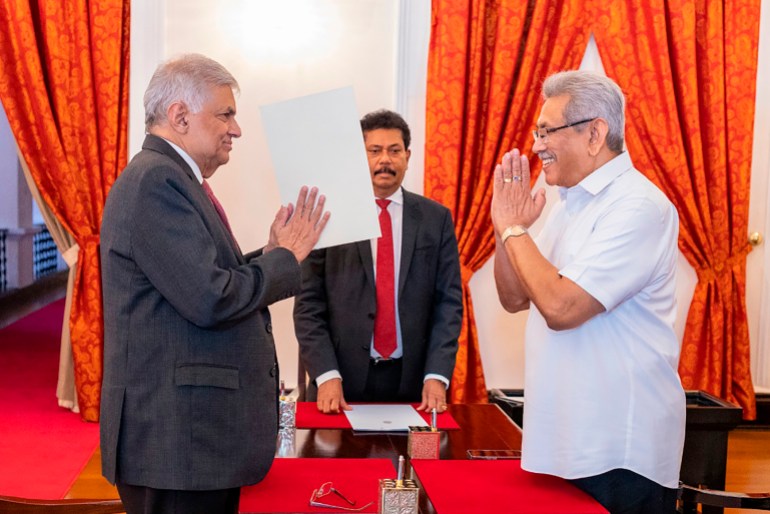
President
Gotabaya Rajapaksa, right, greets Prime Minister Ranil Wickremesinghe
during the latter’s oath-taking ceremony on May 25 [Sri Lankan
President’s Office via AP]
Food inflation has risen to nearly 60 percent, while the crashing of
the Sri Lankan rupee by more than 80 percent since March has further
eroded people’s purchasing power.
Last month, the prime minister said the economy had “collapsed”.
“It’s a big setback to the economy and caused lot of hardship to the
people … We have been taking steps … especially to get gas, which will
be available in the next few days,” he told Al Jazeera, adding supplies
of diesel and furnace oil have also been made.
“The issue has been petrol … and that will take a bit of time.”
Furthermore, the prime minister added that a gas deal has been
secured, with most of the funding coming from the World Bank, which will
ensure supplies for the next four months.